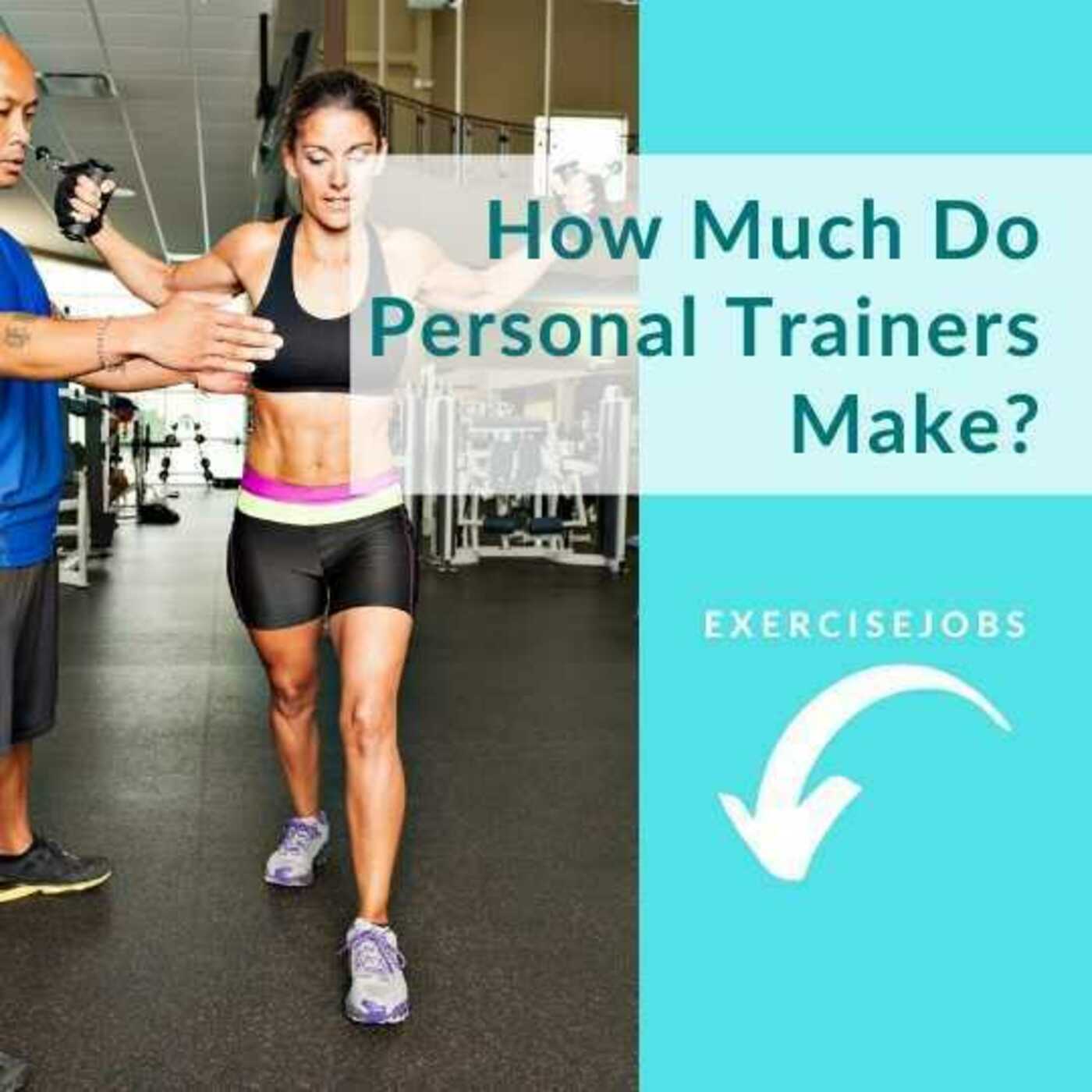
How Much Do Personal Trainers Make?
Learn the latest information on how much a personal trainer makes an hour, a year, and per session, and the multiple factors that play a role in determining personal trainer salary.
You have made the decision to embark on a personal training career and get your personal trainer certification. After selecting a credentialing entity to go through, such as the American Council on Exercise, National Academy of Sports Medicine, or American College of Sports Medicine, you’ve chosen the study program most suitable to your learning needs and budget, diligently completed all the modules, scheduled your exam and passed! You just have one more question before you begin your career. Can you make good money as a personal trainer?
Personal Trainer salary surveys
The American Council on Exercise (ACE) conducted a salary survey among 3,000 ACE Personal Trainers, Fitness Trainers, Group Fitness Instructors, Health Coaches and Advanced Health and Fitness Specialists worldwide.
The ACE report found that the annual average salary for Personal Trainers was $52,537 per year and $26 as an hourly rate.
According to Salary.com, the average Personal Trainer salary in the United States is $64,100, but the range typically falls between $46,245 and $78,747.
ZipRecruiter reports, "the average annual pay for a Personal Trainer in the United States is $50,712 a year. Just in case you need a simple salary calculator, that works out to be approximately $24.38 an hour. This is the equivalent of $975/week or $4,226/month. While ZipRecruiter is seeing annual salaries as high as $96,500 and as low as $19,500, the majority of Personal Trainer salaries currently range between $36,500 (25th percentile) to $58,500 (75th percentile) with top earners (90th percentile) making $77,000 annually across the United States. The average pay range for a Personal Trainer varies greatly (by as much as $22,000), which suggests there may be many opportunities for advancement and increased pay based on skill level, location and years of experience."
Glassdoor estimates total pay for a Personal Trainer is $75,748 per year in the United States area, with an average salary of $48,922 per year.
The U.S. Bureau of Labor Statistics reports that the "median annual wage for fitness trainers and instructors was $40,700, or $19.57 per hour, in May 2021. The median wage is the wage at which half the workers in an occupation earned more than that amount and half earned less. The lowest 10 percent earned less than $22,960, and the highest 10 percent earned more than $75,940".
A quick search in 2022 for How Much Does A Personal Trainer Make in California? gives a bit of range on average salary estimates. Glassdoor (https://www.glassdoor.com/Salaries/san-diego-personal-trainer-salary-SRCH_IL.0,9_IM758_KO10,26.htm) reports that personal trainers in San Diego, CA earn between $50,000 and $82,500 per year. This is broken down into two salary categories: base pay (average $52,092 per year) and additional pay (average $30,383 per year) which can include cash bonuses and sales commissions.
What factors influence a Personal Trainer salary?
There are several variables that can influence how much a personal trainer makes per hour, per month, per year, or even per session. According to Salary.com, salary ranges can vary widely depending on many important factors, including education, certifications, additional skills, the number of years you have spent in your profession.
Here are several variables that can influence how much a personal trainer makes:
- Where you live. ACE’s survey found that certified health & fitness professionals in the Southwest and Northeast regions of the United States had higher hourly and annual salaries compared with those in the Northwest and the North Central regions.
- Where you work. Personal trainers employed at a commercial gym often receive a percentage of the session’s cost (between 30-60% depending on the location) while the remainder is used for the gym’s overhead costs. There is also some variation between gyms in hourly pay and sales commission rates and opportunities for trainers. If you work as an independent contractor or an independent personal trainer at a health club, where you would receive a 1099 tax form from the fitness centers or health club, then you and the club would likely split the revenue you receive from a client training session. If you are a private personal trainer, your pay is determined by what you charge your client for individual or group sessions. You would also like need to find your own clients.
- Years of experience and title progression. Big box gyms often have tiered pay structure systems for levels of experience. Nationwide gym chain Equinox (https://careers.equinox.com/personal-trainers) designates pay for their personal trainers on a tiered system, starting at Tier 2 (considered intermediate level) and culminating at Tier X (designated Coaches with advanced skills). An entry-level Tier 2 PT can earn up to $80,000 in base salary plus sales commission, while a Tier X Coach working 160 sessions per month can earn over $150,000.
- Number of clients. This is perhaps the most significant factor in determining how much a personal trainer makes across the board. Registered Sports Dietitian and Consultant Justin Robinson (https://www.linkedin.com/in/justinrobinsonrd/), who earned his personal trainer certification in the late 1990s, found a typical workday to be 3-4 hours with most clients preferring sessions in the morning or evening. It is important to note that 8 personal training sessions per day is usually not realistic for most personal trainers, as it can lead to burnout very quickly. If you are working as a full-time personal trainer, then you would probably benefit from group fitness instruction, as well, to maximize your hours of work.
Tips to maximize your pay as a Personal Trainer
- Know how to calculate the "cost of acquisition”. Robinson stresses the importance of knowing the amount you’ll need to spend to acquire a new client. You will need to invest in savvy, persistent, and adaptable self-promotion to make potential clients aware of who you are, how you’ll help meet their goals, and how easily they can work with you (offering online personal training sessions is a huge incentive in these times!).
- Stay up to date with changes in the fitness industry. Robinson notes that there have been major changes in recent years, including decreased demand for “big box” gym memberships and 1-on-1 personal training. Small group training and class-based sessions are more popular because they are usually cheaper for clients than individual sessions, while the pay per hour becomes more lucrative for the trainer in a group setting.
- Keep your clients coming back. Whether you work for a gym or have your own business, Robinson insists that a personal trainer’s focus should be on client retention above all else. Every client who returns makes life more financially reliable for the trainer, while finding new clients can be a costly and unpredictable process.
Personal Trainer Salary Takeaways
The U.S. Bureau of Labor Statistics reports that the job outlook for fitness trainers and instructors is extremely bright, with employment projected to grow 39 percent from 2020 to 2030, (which is much faster than the average for all occupations).
A personal trainer can indeed make a good salary. Successful personal trainers maximize their time and client relationships. While there are several variables involved in how much you can make as a successful personal trainer, here are few characteristics that can impact your earning potential:
- Engaging and well-targeted self-promotion
- Willingness to adapt to industry
- Ability to adapt to client environment changes
- Always an enthusiastic, client-centered attitude
Salary ranges can vary widely depending on many important factors, including education, certifications, additional skills, the number of years you have spent in your profession. Being a Personal Trainer can be very rewarding and now you know ways to maximize your personal trainer salary.
If you want to learn more about how to create a successful personal training business, check out this book*.
About the Authors
Alison Rosenstock, MS, RD is a Registered Dietitian and the founder of SDNutritionWriter.com. Her work has appeared on YogiApproved.com, dietitian blog Holly Larson Writes, and Eat Well Crohn’s Colitis. She is passionate about providing evidence-based nutrition education for the public and nutrition expertise for worthy brands and companies.
Stacey Dunn-Emke, MS, RDN, is the Founder Owner of ExerciseJobs and an established health career expert. She helps steer health professionals to a successful job search process. She gives the tools to create a modern standout resume to land that job interview, help with job interview prep, and with creating compelling LinkedIn profiles. Stacey has interviewed and hired many health professionals and in running ExerciseJobs since 2000, she has reviewed thousands of resumes. She works closely with hiring managers and recruiters to know what standout resume elements land a job interview.
